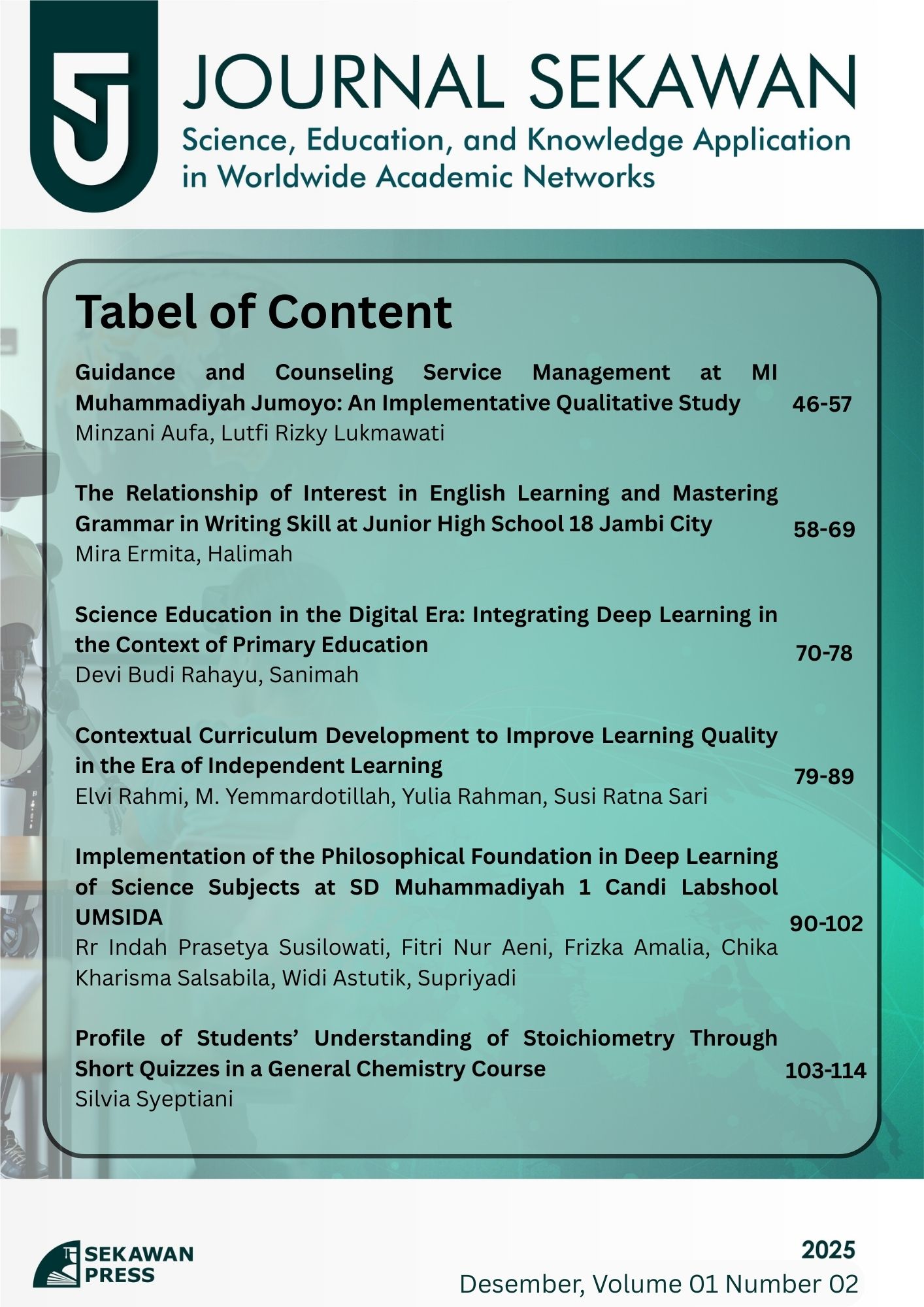
Contextual Curriculum Development to Improve Learning Quality in the Era of Independent Learning
Keywords:
Contextual curriculum, Independent learning, Kurikulum Merdeka, Learning quality, Curriculum developmentAbstract
Indonesia's Freedom to Learn policy opens up opportunities for educational innovation, including the development of a more contextual curriculum. A contextual curriculum links learning materials to the realities of students' lives, making learning more meaningful and effective. This article examines the concepts, strategies, challenges, and impacts of contextual curriculum development in improving the quality of learning within the Freedom to Learn framework. The method used is a literature review, which aims to gain an in-depth understanding of the development and implementation of a contextual curriculum within the context of the policy. The results of the study show that contextual curriculum can strengthen 21st century skills (e.g. thinking skills, collaboration, creativity, communication), increase student motivation, and improve learning outcomes when implemented with adequate teacher support, facilities, and policies. Key challenges include teacher readiness, infrastructure, curriculum load, and policy synchronization. Therefore, it is understandable that contextual curriculum development is a crucial strategy for improving the quality of learning in the Merdeka Belajar era, with recommendations for strengthening teacher capacity, school facilitation, and evaluating the sustainability of its implementation.
Downloads
Published
How to Cite
Issue
Section
License
Copyright (c) 2025 JOURNAL SEKAWAN: Science, Education, and Knowledge Application in Worldwide Academic Networks

This work is licensed under a Creative Commons Attribution 4.0 International License.